


Table of Contents
- Why Safe Online Payment for Luxury Goods Requires More Than a Password
- Secure Online Payment Methods Compared: Credit Cards, Wallets, and Bank Transfers
- Credit Card Protection for Online Shopping: What Actually Covers You
- How to Avoid Online Shopping Scams When Buying Luxury Items
- Safe Checkout Practices: A Step-by-Step Checklist for High-Value Purchases
- International Purchases, Currency Conversion, and Cross-Border Fees
- What to Do After Suspected Payment Fraud on a Luxury Purchase
- Frequently Asked Questions
Last Updated: October 5, 2026
Why Safe Online Payment for Luxury Goods Requires More Than a Password
Safe online payment for luxury goods means matching the payment method to the transaction's risk level, not just entering a password at checkout. At Prime Titan, we sell authentic designer perfumes, 925 sterling silver jewelry, and gourmet gift baskets, so we see how payment anxiety shapes buying decisions every day.
The stakes are real. The Federal Trade Commission's consumer advice on online shopping scams notes that scammers frequently target high-value purchases because the payoff justifies the effort. Meanwhile, the FBI Internet Crime Complaint Center annual report has consistently ranked non-payment and non-delivery fraud among the most reported online crimes.
This guide compares secure online payment methods, explains what each one covers, and gives you a step-by-step checklist for paying safely.
Secure Online Payment Methods Compared: Credit Cards, Wallets, and Bank Transfers
The best secure online payment method for luxury goods is a credit card, because it carries federal dispute rights that wallets and bank transfers do not. But "use a credit card" is only the starting point, the real question is what each method does for you when a $4,000 transaction goes wrong. Below, we compare methods by reversibility, dispute access, evidence requirements, and how long you have to act.
| Payment Method | Reversibility | Dispute Path | Evidence You Must Keep | Typical Window |
|---|---|---|---|---|
| Credit card | High | Chargeback through card issuer | Order confirmation, tracking, seller communications | 60 days from statement for billing errors; longer for fraud per issuer |
| Debit card | Moderate | Dispute through bank, funds already withdrawn | Same as credit card, plus provisional credit request | Often shorter than credit card; varies by bank |
| Digital wallet | High (routes to underlying card) | Dispute filed with the card behind the wallet | Wallet transaction ID plus card records | Follows the underlying card's window |
| Bank transfer / wire | Very low | No chargeback; recovery only via seller or legal action | Wire receipt, contract, seller identity records | Effectively none |
| Buy now, pay later | Moderate | Dispute through the BNPL provider | Installment agreement, delivery records | Provider-specific; often 60-120 days |
| Escrow | High for peer-to-peer | Funds held until buyer confirms receipt | Inspection notes, photos, release authorization | Set by escrow terms |
Credit Cards and Chargeback Rights
Credit cards remain the gold standard for safe online payment because they give you a formal path to dispute a charge. Under the Fair Credit Billing Act, consumers have the right to dispute billing errors, and many card networks extend protections well beyond the legal minimum.
A chargeback is not a refund request, it is a formal reversal initiated through your issuer, who then works with the merchant's bank through the card network's rules. That process takes weeks and depends on the evidence you supply.
Digital Wallets and Tokenized Payment Details
Digital wallets replace your actual card number with a one-time token, so the retailer never sees your real payment details, reducing the damage from a merchant data breach. But their dispute process routes back to the underlying card, so you still need a credit card as the foundation. If you file a dispute, the wallet provider hands the claim to the card issuer, and you will need the wallet transaction ID alongside your card statement.
Bank Transfers, Buy Now Pay Later, and Escrow Options
Bank transfers are fast and cheap but effectively irreversible, use them only with sellers you have verified through independent channels. Buy now, pay later splits a purchase into installments, but if the item never arrives, you are still on the hook for the installments while you dispute the charge. Escrow holds funds until the buyer confirms receipt, making it the safest option when buying from an individual rather than a retailer.
Before any high-value purchase, call your card issuer and ask two questions: what is my dispute window for non-delivery, and what evidence do you require? The answers vary by issuer and will shape how you document the transaction.
Match the method to the risk: credit cards for dispute access, wallets for data minimization, escrow for peer-to-peer, and bank transfers only when you have independently verified the seller and accept the loss risk.
Credit Card Protection for Online Shopping: What Actually Covers You
Credit card protection for online shopping covers unauthorized charges, non-delivery, and items that arrive significantly different from their description, but only if you follow the issuer's dispute window, typically 60 days from the statement date for billing errors, though many issuers allow longer for fraud claims.
What most guides miss is that "protection" is not automatic. You have to do three things:
- Pay with a credit card, not a debit card. Debit disputes are governed by different rules and your money is already gone from your account while the claim is investigated.
- Keep the order confirmation and tracking. Your dispute needs evidence that the item was promised and never delivered.
- File within the window. Miss the deadline and the issuer can decline the claim regardless of merit.
Chargebacks are not a substitute for due diligence. If you paid a seller who never existed, recovery depends on the merchant's response and the network's rules. Prevention still beats recovery every time.
How to Avoid Online Shopping Scams When Buying Luxury Items
Learning how to avoid online shopping scams starts with one habit: verify the seller before you verify the product. Counterfeit luxury goods and fake storefronts are the two dominant threats, and both are defeated by the same discipline. A polished website proves nothing, anyone can build a convincing storefront in a weekend. Red flags to watch for:
- Prices far below market for a known luxury brand
- No physical business address or verifiable contact information
- Payment accepted only by wire transfer, gift card, or cryptocurrency
For fragrances and jewelry, authenticity matters as much as payment safety. Ask whether the seller can confirm the product is genuine and whether it ships from within the country. Prime Titan, for example, ships fast within the U.S. and stocks authentic luxury perfumes and 925 sterling silver jewelry.
Reverse-image search the product photo before you buy. Scam listings frequently steal images from legitimate retailers, and a reverse search will often surface the original listing.
Safe Checkout Practices: A Step-by-Step Checklist for High-Value Purchases
Safe checkout practices come down to three phases: what you verify before you pay, what you check during checkout, and what you do after the payment clears.
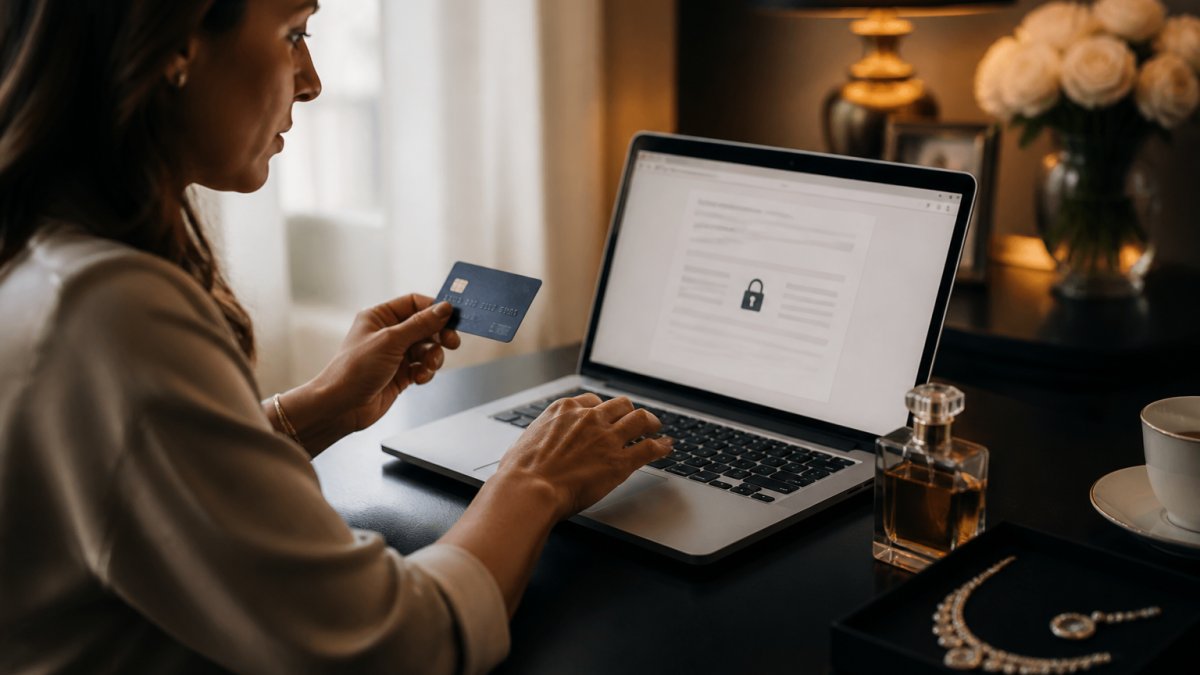
Before You Pay: Verifying the Retailer and the Product
- Confirm the site uses HTTPS and shows a padlock in the address bar
- Search the retailer's name plus "reviews" and "scam" independently
- Verify a real business address and a working customer service contact
During Checkout: Encryption, Payment Gateway, and Transaction Monitoring
- Confirm the payment gateway is a recognized processor, not an unknown form
- Use a credit card or digital wallet rather than a direct bank transfer
- Never email your card number or payment details to anyone
After Payment: Confirmation, Tracking, and Dispute Windows
- Save the order confirmation email and note the expected delivery date
- Track the shipment and confirm the carrier is legitimate
- Inspect the item immediately on arrival and document any damage
International Purchases, Currency Conversion, and Cross-Border Fees
International purchases introduce currency conversion and cross-border fees that quietly add to the cost of a luxury item. Your card issuer may charge a foreign transaction fee, and the exchange rate applied at checkout is rarely the rate you see on a search engine.
Watch for these costs before you confirm an international order:
- Foreign transaction fees, often a percentage of the total
- Dynamic currency conversion markups when paying in your home currency
- Import duties and customs handling charges on delivery
Buying from a domestic retailer removes most of this friction. Prime Titan ships within the U.S., meaning no cross-border fees, no customs surprises, and a dispute process inside familiar consumer protection rules.
What to Do After Suspected Payment Fraud on a Luxury Purchase
If you suspect payment fraud, act within hours, not days, speed is the single biggest factor in whether you recover your money. A luxury purchase raises the stakes because the dollar amount is high and the seller may be overseas, so the plan below focuses on preserving evidence and hitting deadlines.
The First 24 Hours
- Contact your card issuer immediately to freeze the card and flag the charge. Use the number on the back of your card, not one from an email or website, those can be spoofed.
- File a dispute or chargeback in writing, and keep a copy of everything you submit. Verbal disputes are hard to prove later.
- Change your passwords on the retailer's site and anywhere you reused the same credentials. If you used a digital wallet, review its linked cards and remove any you do not recognize.
- Enable two-factor authentication on your email and financial accounts. Account takeover often follows a first fraud attempt.
Preserve the Evidence
Your dispute will be decided on documentation. Before you delete anything, save:
- The order confirmation email and the product listing as it appeared at purchase (screenshot it)
- Tracking numbers, carrier records, and delivery confirmations
- All messages with the seller, including any pressure to pay outside the site's checkout
Report the Fraud
Report the fraud to the Federal Trade Commission at IdentityTheft.gov so the incident is documented. If the fraud involved a wire transfer, contact your bank's wire fraud department the same day, wires can sometimes be recalled if caught quickly, though there is no guarantee. If you suspect identity theft, place a fraud alert or credit freeze with the major credit bureaus.
Monitor and Follow Up
Account takeover often comes in waves. Monitor your statements for follow-up charges for at least 60 days. Keep a log of every call: date, time, representative name, and reference number. If your issuer denies the claim, ask for the specific reason in writing, that gives you the basis for an appeal or a complaint to the Consumer Financial Protection Bureau.
The recovery window is short and evidence-dependent: freeze the card, file in writing, preserve every record, report to the FTC, and follow up for at least 60 days.
Frequently Asked Questions
What is the safest way to pay for luxury goods online?
Credit cards remain the strongest option for safe online payment because federal law limits your liability for unauthorized charges and gives you chargeback rights if goods never arrive or are counterfeit. Digital wallets add another layer by tokenizing your card number so the retailer never sees it. For peer-to-peer or resale transactions, use an escrow service that releases funds only after you confirm the item is authentic and as described.
Should I use a credit card to buy luxury goods online?
Yes, a credit card is generally the best choice for credit card protection for online shopping. Under the Fair Credit Billing Act, your liability for unauthorized charges is capped at $50, and you can dispute charges for goods that were never delivered or were not as described. Debit cards offer weaker protections, and bank transfers or gift cards leave you with almost no recourse if something goes wrong.
How can I tell if an online luxury retailer is legitimate?
Check for a physical U.S. business address, a working customer service phone number, and clear return and refund policies. Look for HTTPS encryption and a recognized payment gateway at checkout. Search the brand name plus 'scam' or 'reviews' to see complaints. Be cautious of prices far below market rate, pressure to pay by wire transfer or gift card, and sites with no verifiable contact information.
What should I do if I think an online luxury purchase is fraudulent?
Contact your credit card issuer or bank immediately to dispute the charge and request a chargeback. File a report with the FTC at ReportFraud.ftc.gov and your state attorney general's office. Save all emails, order confirmations, and screenshots. If you paid through a digital wallet, open a dispute through that platform as well. Acting within 60 days of the statement date preserves your dispute rights under federal law.
Buying luxury goods online should feel as secure as it does special, and that comes down to choosing the right payment method for the risk. Prime Titan supports that with secure checkout, authentic luxury perfumes and 925 sterling silver jewelry, and fast U.S. shipping, so you can pay with confidence and enjoy what you bought. Get started with Prime Titan and shop our collection of fragrances, fine jewelry, and gourmet gift baskets today.
Leave a comment
All comments are moderated before being published.